


Relationship authorities play an important role in XOBIS because most of XOBIS' usefulness comes from its relationships.
In fact, with our emphasis on access rather than on description, much of what is expressed, as description in MARC, becomes a relationship in XOBIS.
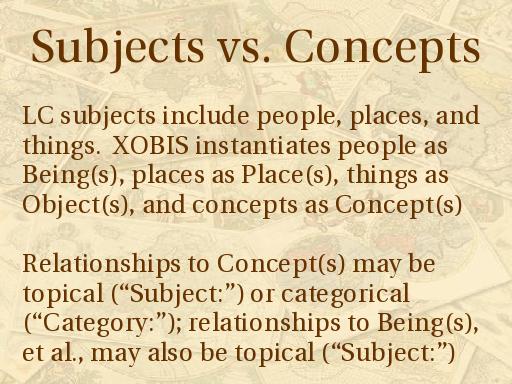
The most obvious example of this is with Concepts. It is important to keep in mind that XOBIS' Concepts will not match LC's subject headings.
For example... a conceptual relationship named "Subject:" indicates that a Work is about the "Medical Colleges" topic; a conceptual relationship named "Category:" indicates that an Organization is a member of the "Medical Colleges" class. "Medical Colleges" is represented in the database by a single Concept record. It is the aboutness or isness of the relationship to it that varies.
Another example is the relationship of a work to a person. A Work may have an "Author:" relationship to one person and a "Subject:" relationship to another. There is nothing in each of these Being records that says how it is used. The Being is a discreet entity. XOBIS relies on relationships to that entity to provide the context needed by the Work record.
Likewise, the Being that was used as the target of the Work relationship may have a Being to Being relationship named "Father:". That Being record might have a Being to Organization relationship named "Alumnus:" The web of relationships could grow much like the Web has.
Unlike the Web, though, we expect that the navigational type of a relationship, expressed as a 'type' attribute, will assist with browsing through a library database.
We have also included an unspecified attribute value for mapping convenience.