


The last goal in the development of XOBIS was to reduce the complexity of the schema by using the database to validate select schema values.
We will not know whether we have succeeded in doing this, of course, until we load a database full of XOBIS records and try to use this structure to validate our record values.
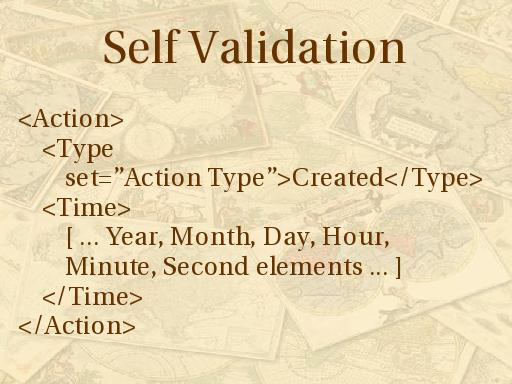
The most common example of using the database to validate data is the Type element's 'set' attribute. The example on this slide is an excerpt from the ControlData section of a XOBIS record. In it, there is an Action that represents an action taken on the record.
This action's Type element informs us that the action represented is the creation of the record.
Now, suppose a library wants to control the types of actions that may be performed on its records. Instead of maintaining an external list of acceptable actions, XOBIS provides for the ability to limit the set of potential values to a particular set of records from the database.
This 'set' attribute tells the XOBIS-aware editor that it should look for a XOBIS Concept records that have a relationship to the "Action Type" Concept.
All the records it finds are considered acceptable values. These records might include a "Suppressed" Concept record, an "Updated" Concept record, and a "Created" Concept record.
The same principle works for the Type element regardless of where it is used in the schema. For instance, a XOBIS database may contain "Record Type" Concept records, "Note" Concept records, and "Physical Description" Concept records. These may be used to limit acceptable values throughout the schema.
After we finish mapping our own records to XOBIS, we do expect to offer a core set of seed records that would contain some basic Concept records for use with the Type element. We also expect to include some that serve as relationship authorities.