


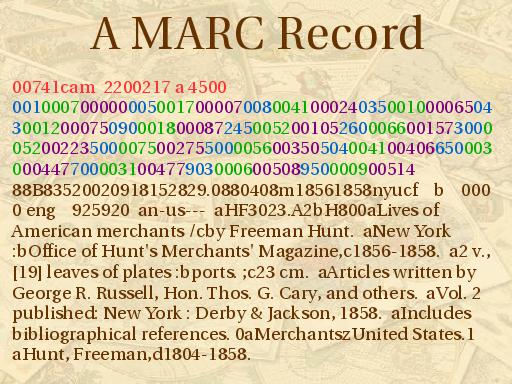
Though you have probably seen a display MARC record, on this slide I've reproduced a real MARC record. Keep in mind that MARC records do not have end of line characters; line wrapping is something I've added. I've also color coordinated the record to make it easier to read.
Generally speaking, MARC records consist of a leader, represented here in red, a directory, and a variable length, field data section, represented here in black. The record's leader and directory are predictable. The leader is 24 bytes long and the directory consists of entries that are each twelve bytes long.
Each twelve byte entry contains information about a field in the record's variable length, field data section.
For example, the first three bytes of an entry contain the field's tag. In this example, these are colored blue. The next four bytes contain the field's length. These are colored green. The final five bytes of the entry contain the field's byte offset within the record as a whole. These are colored purple.
The record's field data, at the end of the record, consists of control fields and variable length fields. Control fields contain data values that are often distinguished by byte position and variable length fields contain indicators and subfields, each representing a discreet unit of information.
Some of these fields are repeatable while others are not.
This flat structure conveys MARC data in a very efficient manner. Efficiency, however, has its trade-offs.
It is interesting to note that many of the modern integrated library systems maintain the MARC record in its entirety within a BLOB or VARCHAR within the database while, at the same time, extracting specific parts of the record for inclusion in searchable database tables.
Is this because the MARC record inherently contains information that is too valuable to discard, but too complex to practically use?