


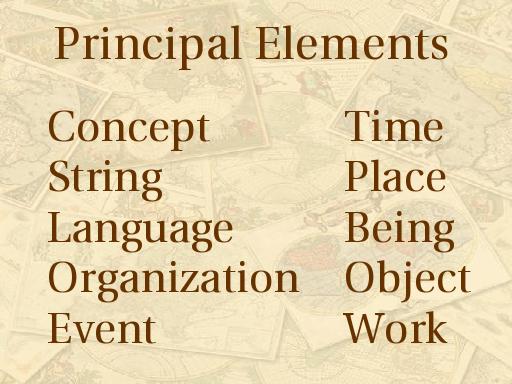
In the Xobian worldview, there are 10 basic types of information. These are the principal elements: Concept, String, Language, Organization, Event, Time, Place, Being, Object, and Work. Since each XOBIS record will only have one principal element, XOBIS records may be referred to as Work records, Language records, Time records, and so on.
Of these ten elements, Concept is the most fundamental. Concepts are topical and/or categorical constructs that are not otherwise instantiated in the XOBIS schema. XOBIS' other nine principal elements may be thought of as Concepts that have been instantiated.
String records are similar to Concept records except that they contain a word, phrase, letter, or number that probably does not warrant a Concept record. They may be used to resolve problems resulting from variant spellings, archaic usages, and other linguistic variations.
Records with a Language principal element contain written, spoken, or signed communication systems. This includes artificial and fictional languages, but excludes computer programming languages, shorthand systems, alphabets, fonts, etc.
XOBIS' Organization records represent named organizations and corporate bodies, including jurisdictional subdivisions. We consider top level juridictions to be Place(s) because they are, for the most part, inextricably linked to a geographic location.
Records that contain an Event as the principal element serve to describe named macro-events that occur naturally or are conducted by individuals or organizations. Like Organizations, Event(s) may be disambiguated by Qualifiers, providing for a hierarchical structure while maintaining the form of the name found in current MARC records.
Chronological records are, as you would expect, authoritative forms of a single time or duration. XOBIS' comprehensive time structure is used consistently throughout the schema, though there are a bewildering number of possibilities for its internal structure. Place records are records that encompass physical geography, political geography, and virtual geography. Place records have an attribute that indicates whether the record functions as an authority record or a Place instance; instances are cases where a place may actually be collected by a museum or library.
Like Places, Beings, Objects, and Works may be authoritative, instances, or both an authority and an instance.
An example of this would be Being records created for elephants. A zoo may own a family of elephants; there might also be a Being authority record for a particular Thai elephant whose paintings are sold in New York. If one of Thailand's painting elephants is given to the zoo, there may be a need for a record that serves both as an authority and as an instance.