


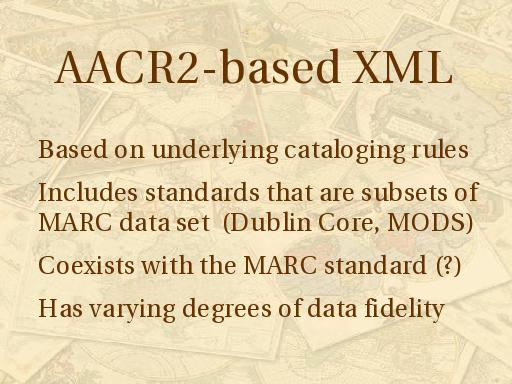
The second option Fiander mentions in his article is to create an XML schema based on the rules of AACR2.
He sees our initial DTD as an example of this approach because we created some tags, like title and author, based on the underlying data elements in our records. You might remember I also included our DTD in the first category because of our reliance on MARC tags for fields we don't actually use.
I would suggest that this second category should contain some of the projects that are attempting to create subsets of the data used to describe bibliographic records. These subsets are not meant to replace MARC, but rather to describe some basic units of library information. The Dublin Core and LC's MODS, Metadata Object Description Schema, might be examples of this category.
The more interesting of these two, to me, at least, is the MODS project. MODS is an attempt to create a subset of the information used to describe library resources. It is higher fidelity than the Dublin Core and has some features that will, in my opinion, improve information retrieval.
Like the Dublin Core, MODS is not intended as a replacement for MARC. As a result, there is some confusion as to how libraries should use it. Should libraries maintain two separate data structures? How do we decide which resources to catalog in MARC, or MARC XML, and which ones should be cataloged in MODS?