


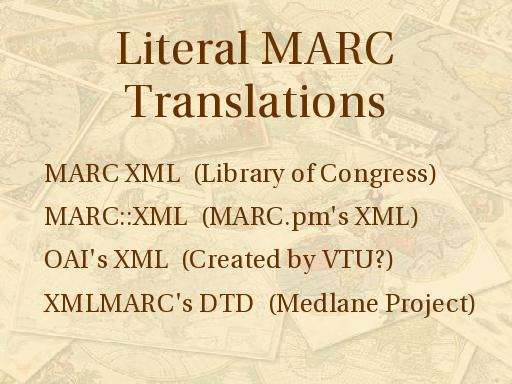
The best example of the first alternative, creating a schema based on MARC, is the MARC XML schema created by the Library of Congress.
Prior to the release of MARC XML, there were several literal translations of MARC available in the library community: MARC.pm, a PERL library for working with MARC records, has one; OAI, the Open Archives Initiative has one; and there is, of course, the DTD we shipped with the XMLMARC program.
I include ours here because even though we did create many original elements, we relied on MARC tags for fields we don't use.
Now that the Library of Congress has released a "standard" schema for the literal representation of MARC in XML, I would imagine that libraries interested in this type of representation will use it instead of these alternatives.
So, should XML replace MARC? The LC response, based on the release of their literal schema, seems to be "No."
While marking up MARC in XML will make it easier to process, none of the organizational problems associated with the MARC format are addressed by this solution.
It will certainly be easier to display a MARC record online with MARC XML, but I question whether the data will really be that much more accessible.
As David Fiander says in his article: the primary disadvantage of an XML schema based on the literal translation of MARC is that it will fail to take advantage of the ability of XML to describe shared structures within the data.