Exploration of the brain from the medial aspect
Relations of fornix, dentate fascia and hippocampal gyrus to corpus callosum
Stanford holds the copyright to the David L. Bassett anatomical images and has assigned
Creative Commons license Attribution-Share
Alike 4.0 International to all of the images.
For additional information regarding use and permissions,
please contact the Medical History Center.
Image #19-1
Exploration of the brain from the medial aspect
Relations of fornix, dentate fascia and hippocampal gyrus to corpus callosum
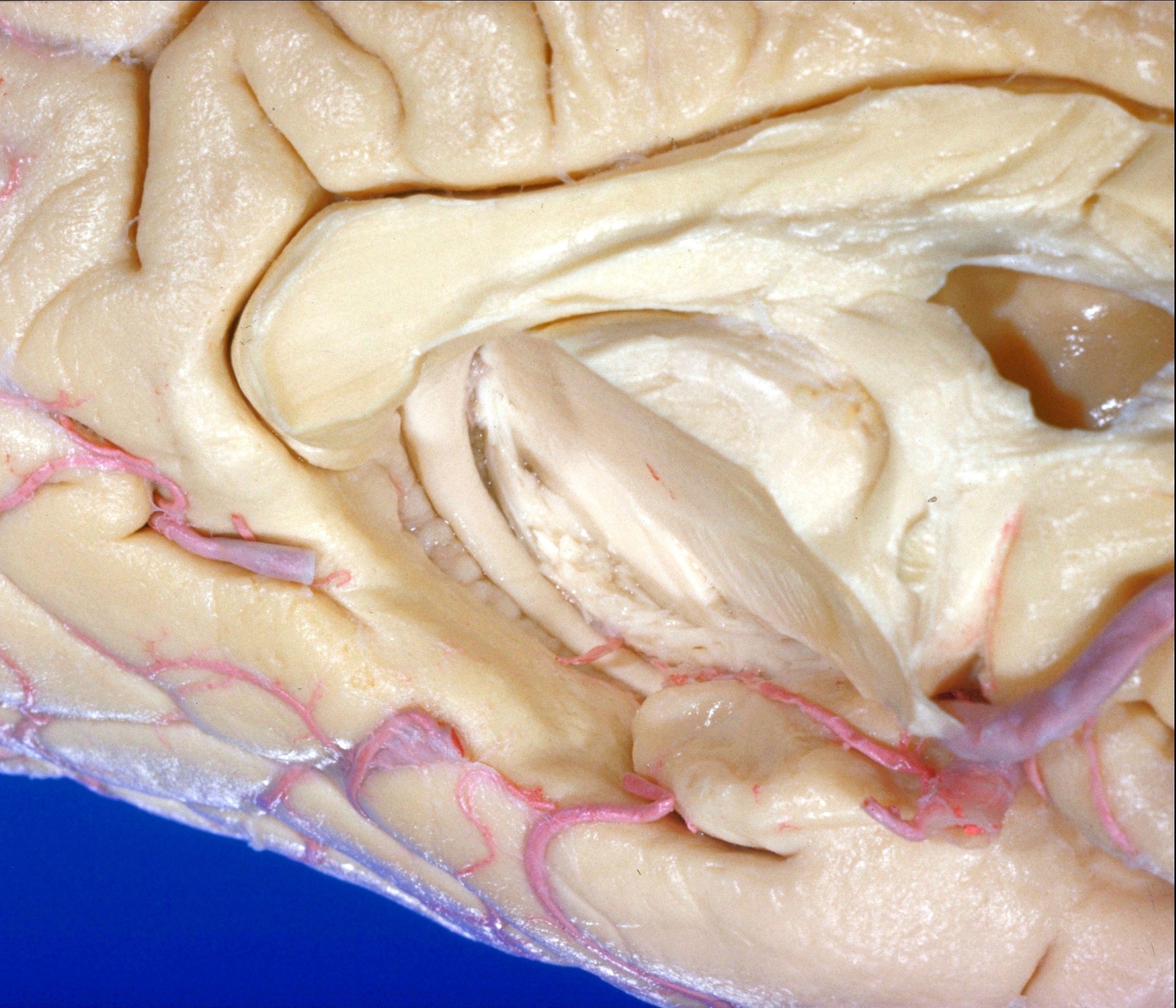
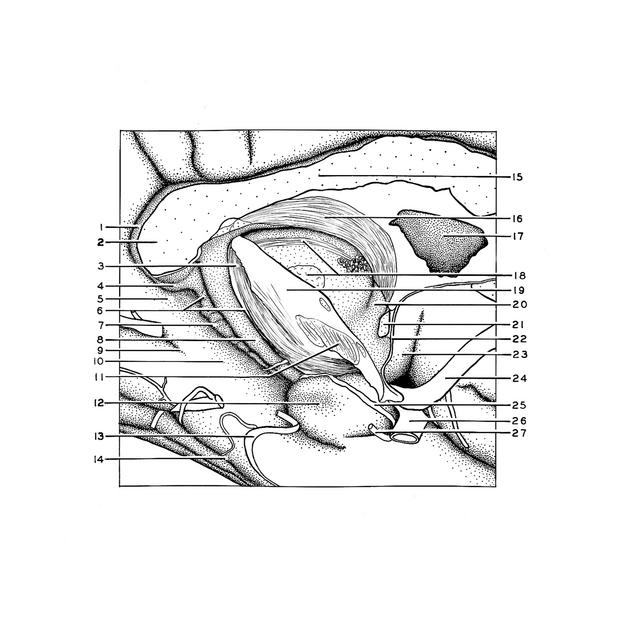
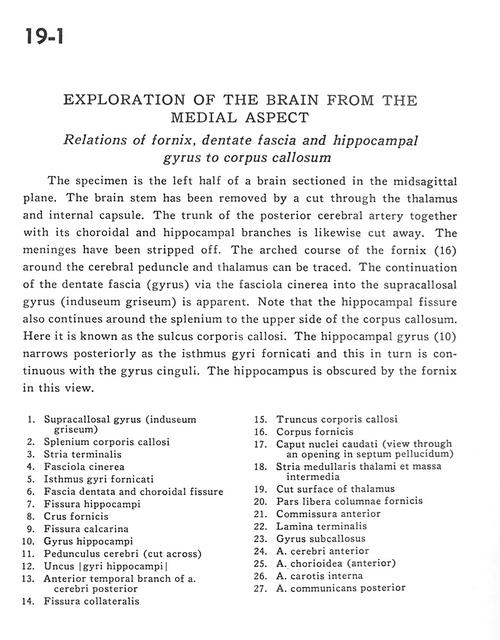
The specimen is the left half of a brain sectioned in the midsagittal plane. The brain stem has been removed by a cut through the thalamus and internal capsule. The trunk of the posterior cerebral artery together with its choroidal and hippocampal branches is likewise cut away. The meninges have been stripped off. The arched course of the fornix (16) around the cerebral peduncle and thalamus can be traced. The continuation of the dentate fascia (gyrus) via the fasciola cinerea into the supracallosal gyrus (induseum griseum) is apparent. Note that the hippocampal fissure also continues around the splenium to the upper side of the corpus callosum. Here it is known as the sulcus corporis callosi. The hippocampal gyrus (10) narrows posteriorly as the isthmus gyri fornicati and this in turn is continuous with the gyrus cinguli. The hippocampus is obscured by the fornix in this view.
- Supracallosal gyrus (induseum griseum)
- Corpus callosum (splenium)
- Stria terminalis
- Band of gray matter
- Limbic lobe
- Dentate fascia and choroidal fissure
- Hippocampal fissure
- Fornix (crus)
- Calcarine fissure
- Hippocampal gyrus
- Cerebral peduncle (cut across)
- Uncus (hippocampal gyrus)
- Anterior temporal branch of posterior cerebral artery
- Collateral fissure
- Corpus callosum (trunk)
- Corpus fornicis
- Head of caudate nucleus (view through an opening in septum pellucidum)
- Stria medullaris thalami and massa intermedia
- Cut surface of thalamus
- Free part of column of fornix
- Anterior commissure
- Lamina terminalis
- Subcallosal gyrus
- Anterior cerebral artery
- Choroidal artery (anterior)
- Internal carotid artery
- Posterior communicating artery